

















Beyond the Spec Sheet: Climate-Proofing Micro Storage and the Psychology of Uninterrupted Power
April 29, 2026


The transition toward decentralized power has accelerated the adoption of the residential energy storage system. However, a critical industry pain point persists: standard batteries are often designed for ideal, climate-controlled environments. When sudden grid failures cause smart home networks to crash, or when winter freezes cripple battery capacity, end-users are left vulnerable. As energy solutions move outward—expanding into exposed environments via balcony storage and balcony battery setups—these environmental constraints become even less forgiving.
Energy storage systems are often evaluated in laboratories, but their true value is proven during real-world anomalies. Extreme weather events and the resulting grid instability expose the vulnerabilities of standard micro storage units. For systems like the GoodWe ESA Athena, surviving these conditions requires a dual approach: maintaining electrochemical stability in harsh climates and ensuring imperceptible transitions during grid failures.
Thermal Engineering for Climate Extremes: How Does Extreme Cold Affect Lithium-ion Battery Life?
Lithium-ion batteries face severe physical limitations at temperature extremes. In freezing conditions, charging can cause lithium plating on the anode, permanently degrading the cell's State of Health (SOH) and drastically reducing available capacity.
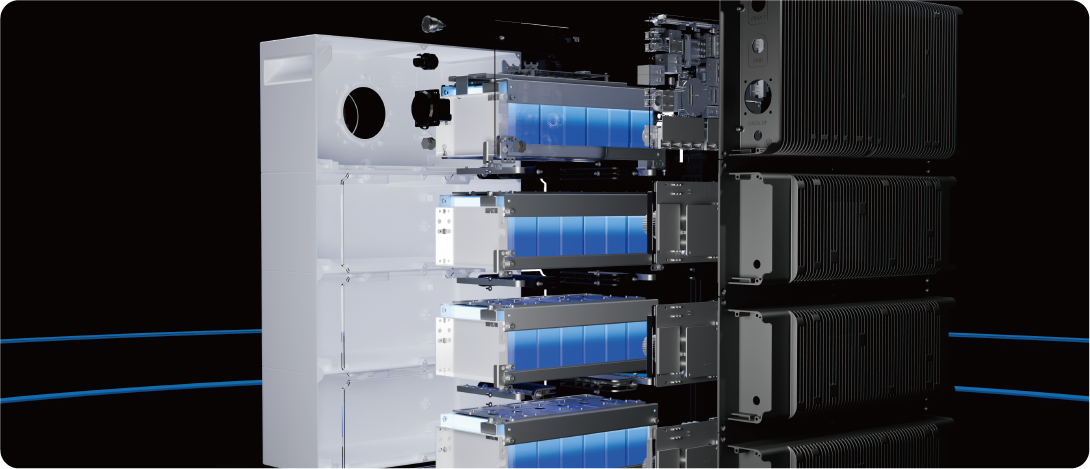
To manage temperature across this 75-degree window, we employ a Negative Temperature Coefficient (NTC) resistance heating film. Traditional metals are positive; they become more resistive to electricity as they heat up. NTC materials work inversely: their electrical resistance decreases significantly as temperature rises. In Athena, this property is harnessed for surgical precision. The heating element is an ultra-thin, flexible film composed of advanced conductive inks or ceramic layers, applied directly to the battery cell structures.
When winter temperatures approach -20°C, the cells are too cold to safely accept a charge. The system activates the heating film. Because the NTC film’s resistance is predictable across the temperature curve, it works seamlessly within a closed-loop feedback system. The BMS monitors separate NTC sensors, applies the full rated power to the film for rapid warmth, and modulates that power as the cells approach their safe operational threshold, ensuring energy efficiency and preventing localized overheating. A dedicated structural insulation pad at the base prevents this thermal energy from dissipating into the external metal casing. This focused heating mechanism guarantees deep cycling capabilities even in severe winters, effectively eliminating the industry-wide pain point of "winter capacity drop-off" for exposed balcony battery systems.
The 10ms Metric and the Psychology of Security: Why is the Backup Switch Time Critical for Modern Homes?
When extreme weather compromises the grid, the speed of a storage system’s response is just as critical as its capacity. Standard backup systems often experience a 20ms to 50ms delay during grid failure. This gap forces sensitive electronics, such as desktop computers, NAS servers, routers, and critical medical devices, to reboot.
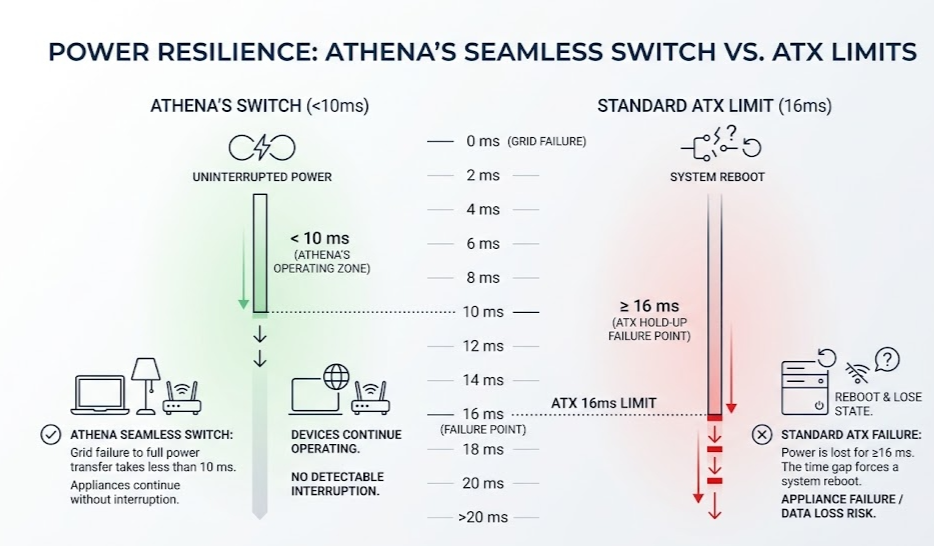
By implementing an ultra-fast off-grid detection algorithm and high-grade relays, the Athena achieves a seamless backup switch time of less than 10 milliseconds. This metric is critical because standard IT power supplies possess a "hold-up time" of approximately 16 milliseconds. A sub-10ms switch ensures that connected appliances ride through the blackout without detecting interruption.
A Holistic Approach to Resilience: What Makes a Home Battery Truly Climate-Resilient?
True resilience operates on two levels. Hardware mechanisms like built-in aerosol fire suppression provide tangible, physical safety by neutralizing extreme thermal risks within compact micro storage enclosures. Concurrently, the <10ms seamless switching capability provides profound psychological security. End-users are isolated from the anxiety of flickering lights, dropped conference calls, or resetting smart home infrastructure.
Modern micro storage is no longer just a reservoir for excess solar energy. By combining active thermal management with UPS-grade switching speeds, it acts as a climate-resilient buffer between the chaos of the external grid and the stability of the modern home.


